
Conflict gets a bad reputation in workplaces. Say the word “conflict” in a meeting and you can almost feel people tense up, shoulders tighten, eyes dart, voices get careful. But here’s the truth: a team with no conflict isn’t necessarily a healthy team. It may be a team that has learned to stay quiet.
In fact, teams don’t need less friction. They need better friction.
The goal of facilitation isn’t to eliminate conflict. The goal is to keep conflict productive, to help teams disagree without damage, explore differences without turning personal, and use tension as fuel for clearer thinking instead of collateral harm.
Without disagreement, teams drift into groupthink, where the first idea becomes the only idea, risks stay hidden, and “innovation” becomes a slogan instead of a practice.
The hard part? What looks like conflict isn’t always the real conflict. And what sounds like agreement isn’t always alignment.
Let’s break down what facilitators need to notice, what’s often happening under the surface, and how to intervene in ways that restore clarity, dignity, and forward movement.
Conflict vs. confrontation: the distinction that changes everything
A helpful starting point is separating conflict from confrontation.
Conflict is a difference of opinion, perspective, or preference. It’s disagreement. It’s competing ideas. It can be healthy. In fact, teams need it.
Confrontation is what happens when conflict turns personal, combative, or unsafe. It’s when disagreement shifts from “Let’s find the best idea” to “My idea is better than yours” or “I’m right and you’re wrong.” It can also be more subtle: passive resistance, sarcasm, shutdown, or compliance-with-an-eye-roll.
A team can have conflict and still be respectful, curious, and effective. A team in confrontation is no longer collaborating, they’re protecting themselves.
As a facilitator, your job isn’t to be a peacekeeper who silences dissent. Your job is to keep the room on the healthy side of the spectrum, where disagreement stays centered on the work, not the worth of the people doing it.
What conflict looks like in meetings (and what it really is)
Many people think conflict only exists when it’s loud: raised voices, blunt disagreement, overt pushback.
That’s the obvious version. And yes, facilitators should be ready for it. But the more dangerous version is the conflict you don’t see.
Here are two categories to watch:
1) The visible conflict
This is what people typically label as conflict:
- “I don’t like that idea.”
- “That won’t work.”
- “We tried that before.”
- Interruptions and crosstalk
- Two people talking “through gritted teeth”
- Sarcasm, snark, and point-scoring
- Cliques forming in the room (side conversations, whispered alliances)
This conflict may be messy, but it’s at least out in the open – which means it can be worked with.
2) The invisible conflict
Invisible conflict is the meeting that looks calm… but isn’t aligned:
- Silence after a strong opinion
- Quick agreement that feels too fast (“Yep, sounds good!”)
- People disengaging, leaning back, folding arms
- Cameras on but attention elsewhere – eyes off-screen, multitasking
- People “giving up” to avoid the energy cost of pushing back
- A pattern of “consensus” that happens every time, regardless of the stakes
Sometimes this shows up as what we call resigned consensus – agreement not because people support the idea, but because they don’t have the energy, safety, or perceived permission to challenge it.
When people stop contributing, when they choose compliance over candor, conflict hasn’t disappeared. It has gone underground. That’s where it becomes expensive: it turns into rework, resentment, low ownership, and decisions that quietly fail later.
A facilitator’s radar needs to be tuned not just to what’s said, but to what’s withheld.
The iceberg model: what’s above the surface vs. what’s underneath
One of the most useful ways to think about conflict is as an iceberg.
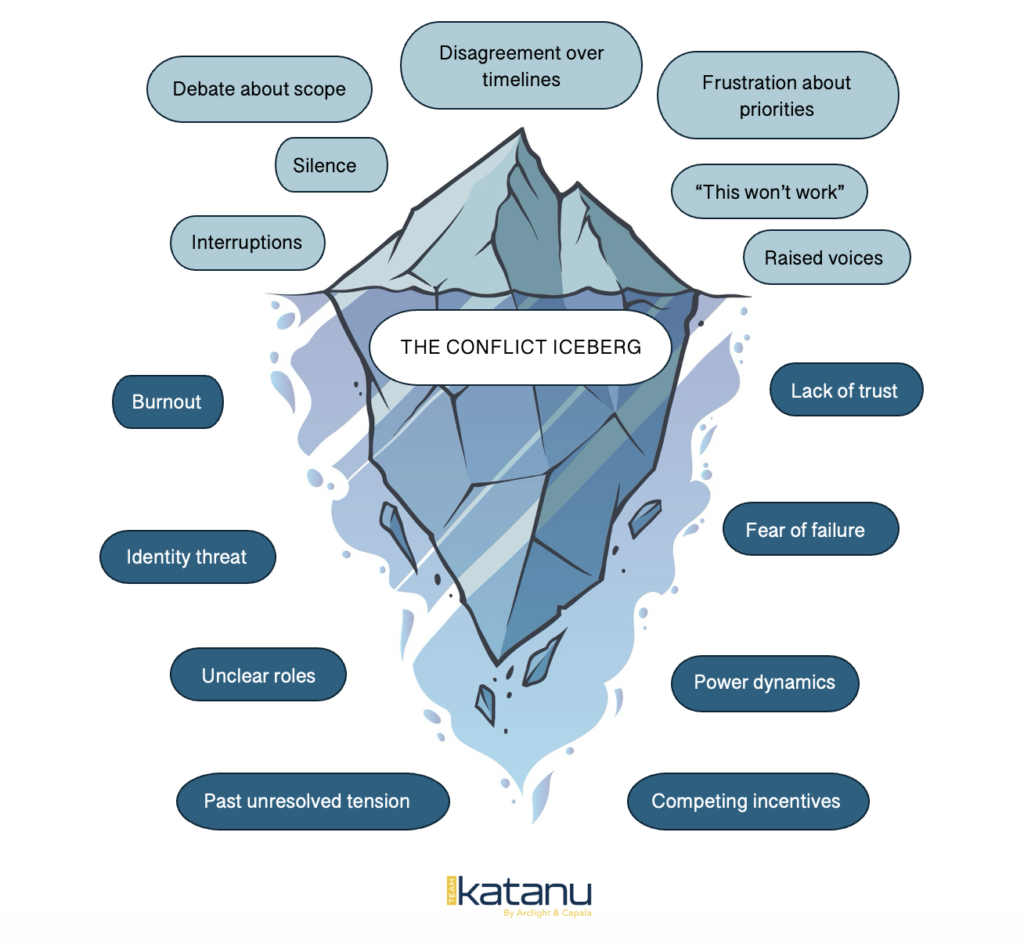
Above the surface (what you can see/hear)
- Words: “Yes, but…” “I don’t agree.” “You said…” “I’m telling you…”
- Tone shifts: clipped speech, escalating volume, sarcasm
- Behaviors: interrupting, eye-rolling, dominance, withdrawal
- Meeting patterns: stalled decisions, looping arguments, sudden silence
Below the surface (what’s actually driving it)
- Power dynamics (“Can I disagree safely?”)
- Low psychological safety
- Unclear roles or decision rights
- Conflicting agendas between teams/departments
- Past unresolved issues (the “we’ve been here before” layer)
- Lack of shared context (people talking past each other)
- Insecurity, fear of being judged, fear of looking wrong
- Competing priorities and scarce resources
- The “Hollywood problem” – someone arriving with a pre-written script, determined to get their way regardless of what unfolds in the room
This matters because facilitators often try to solve the “above the surface” behavior (stop interrupting, lower the temperature) without addressing what’s underneath (lack of clarity, misalignment, fear, or unresolved tension).
You can calm a room without fixing the conflict. But the conflict will return – just later, and usually more expensively.
Early warning signs facilitators should notice
The best facilitators don’t wait until the meeting is on fire. They intervene when the smoke shows up.
Here are early signals that “all is not well”:
- The language changes: “Yes, but…” “I don’t agree…” “You always…” “That’s stupid…”
- The room goes quiet after someone speaks, especially if it’s followed by forced agreement
- People disengage physically: leaning back, arms crossed, slumped posture
- Micro-signals of contempt: eye-rolls, smirks, side glances
- Volume patterns shift: animated discussion → silence → unrelated chatter
- One person dominates while others fade
- Fast agreement becomes the norm (especially on complex issues)
A key insight: silence can mean many things – reflection, confusion, fear, resignation. A facilitator doesn’t assume. A facilitator gets curious.
Practical facilitation moves that keep conflict productive
Here are facilitation techniques that reliably help teams move from confrontation back to healthy conflict.
1) Name what you’re noticing (without blaming)
When tension rises, your calm observation can reset the room.
Examples:
- “I’m noticing we have a few different perspectives here.”
- “I’m hearing competing priorities – let’s slow down.”
- “It sounds like we’re debating the idea, and I want to make sure it doesn’t turn into debating the person.”
Naming brings the invisible into the shared space, without accusing anyone of being “the problem.”
2) Slow it down on purpose
Escalation thrives on speed. Facilitation creates space.
Try:
- “Let’s pause for 30 seconds.”
- “Before we respond, I’m going to summarize what I’m hearing.”
- “Let’s take one minute silently to write down concerns and risks.”
A short pause can prevent a reactive comment that changes the tone of the whole meeting.
3) Separate people from ideas
A classic failure mode is when disagreement becomes identity-based.
Help the team keep the disagreement on the topic:
- “What specifically about this idea concerns you?”
- “What risks are you seeing?”
- “What would make this safer or more workable?”
This shifts the debate away from “me vs. you” and back to “us vs. the problem.”
4) Use a visual map to reduce misunderstandings
Misunderstanding is a major driver of conflict.
A simple move: put the key points on a whiteboard (physical or digital):
- What decision are we making?
- What options are on the table?
- What constraints exist?
- What are the top risks/assumptions?
Then ask: “Is this an accurate representation of what we’re discussing?”
Seeing it reduces the “talking past each other” effect and gives the group a shared anchor.
5) Balance participation to reduce dominance
When confrontation is driven by a few voices, participation design is your best lever.
In those moments, your job is to change the physics of the room – not argue with dominance, but redesign the interaction.
Tools:
- Stacking: “I have Sam, then Priya, then Jordan.”
- Round robin: each person gets one minute
- Silent brainstorm + share: write first, then speak
- Pairs/breakouts: discuss in twos, then return with one shared point
When more people can contribute safely, tension spreads out and becomes easier to work with.
6) Shift from confrontation to curiosity
Curiosity defuses defensiveness.
Curious prompts:
- “What’s important to you about that?”
- “What are you protecting?”
- “What would success look like from your perspective?”
- “What’s the concern underneath the concern?”
When people feel heard, their nervous systems settle – and they become more capable of problem-solving.
Two high-impact techniques for heated moments
Technique A: Said – Heard – Meant
This is ideal when two people are stuck and misinterpreting each other.
Process where Person A and Person B are in a cycle of misunderstanding.
SAID
- Prompt to Person A: “Person A, please restate exactly what you said to Person B
- Action: Person A speaks. Person B must listen without responding.
HEARD
- Prompt to Person B: “Person B, in your own words, what did you hear Person A say? What was the message you received?”
MEANT
- Prompt to Person A: “Person A, now that you’ve heard what Person B received, tell us: what did you actually mean to communicate?”
This structure creates a clean loop of listening and correction – without interruptions. Often, the “conflict” dissolves when people realize they weren’t arguing about the same thing.
Technique B: Rotating debates (steel manning)
When people are locked into “my idea vs. your idea,” this technique creates perspective.
The rule: you must defend the other person’s idea as if you fully believe it. No “I don’t agree, but…” disclaimers.
One reason this works is neurological: our brains tend to lower their defenses when we hear an argument coming from our own voice. By articulating the opposing view fully and fairly, we create cognitive flexibility, and sometimes discover the idea wasn’t as wrong as we thought.
This isn’t about winning. It’s about surfacing the strongest thinking on both sides so the team can integrate, refine, or choose intelligently.
What about the person who comes to dominate?
Sometimes the meeting isn’t stuck because of misunderstanding. It’s stuck because someone arrives with a script, determined to drive the outcome regardless of what unfolds.
That’s when facilitation becomes design.
Use:
- Round robin
- Time-boxed speaking turns
- Silent idea generation
- Explicitly capturing multiple options before evaluation
You’re not there to “beat” the dominant voice. You’re there to ensure the room doesn’t orbit around it.
If the behavior becomes aggressive, threatening, or crosses into HR territory, pause and escalate appropriately. Facilitators are not referees for toxic conduct!
The facilitator mindset: hope is not a strategy
One of the easiest facilitation traps is waiting and hoping it gets better.
It usually doesn’t!
Conflict that stays unaddressed will either:
- escalate into confrontation, or
- disappear into silence and reappear later as resistance, sabotage, or rework
Healthy conflict is not something to fear. It’s something to design for.
A meeting without conflict is often a meeting where nothing new is being born.
So don’t eliminate the rub. Facilitate it.
Notice the tone shifts. Notice the silence. Notice the eye rolls. Name what’s happening. Slow it down. Change the structure. Create space for disagreement without damage.
Conflict isn’t the enemy.
Unmanaged confrontation is.
And productive friction – skillfully facilitated – is one of the most powerful forces a team can harness!