
The Etiquette Gap Killing Your Meetings
Look at your calendar for a typical week. How many hours are spent in meetings? Now multiply that time by the number of people attending

Look at your calendar for a typical week. How many hours are spent in meetings? Now multiply that time by the number of people attending
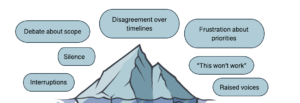
Conflict gets a bad reputation in workplaces. Say the word “conflict” in a meeting and you can almost feel people tense up, shoulders tighten, eyes

Most meetings aren’t failing because people don’t care!They’re failing because the meetings were never designed for participation in the first place. You can see the

We have done Scrum. We have done Kanban. This week Kate Megaw, Anu Smalley and Ryan Smith take on everything else, starting from one question: did anything else survive the evolutionary process? Plenty did, depending on where in the world you work and what you build. The list runs from XP and Lean to Crystal, DSDM and Scrumban. Next comes DevOps, and why two week Sprints with six week deployments made it inevitable. Then XP, the software-only framework that gave everyone else user stories and velocity, plus the person who wrote “As a, I want, so that.” It is not who you might think. Then the case for Lean as the root of every agile framework, and why cutting waste beats faking Scrum. “Agile in HR” gets retired in favor of HR agility. Then scaling: SAFe, LeSS, Scrum@Scale, Nexus and Disciplined Agile, why leaders love them, and what happens when you scale a team-level mess. It closes where every framework choice should start: what problem are you trying to solve?
Last week was Scrum. This week Kate Megaw, Anu Smalley and Ryan Smith turn to Kanban, the framework most teams think they already know because they have a board. They trace it back to Toyota and just in time manufacturing, then walk through the part that usually gets skipped: the three change principles, the three service delivery principles, and the six general practices behind the board. Ryan explains why work in progress limits are the practice people blow past first, and how he uses Kanban to calm a chaotic team. Anu orders a pizza to show why no organization has only one workflow. Kate shares the client board that showed a client it had the wrong mix of roles, and all three take on the practice everyone forgets: making policies explicit. Along the way: the theory of constraints, Kanban for refinement alongside Scrum for development, and why your teams do not all need the same process.
Last week was frameworks for agility in general. This week Kate Megaw, Anu Smalley and Ryan Smith put the best known one under the microscope. They walk through where Scrum came from, why Ken Schwaber and Jeff Sutherland waited fifteen years to write it down, and what the new Simple Guide to Scrum from Bob Hartman and Tobias Mayer changes. Kate makes the case for the 2020 switch from roles to accountabilities, and it turns out the three hosts cover all three of them between them. Then the can of worms: can you implement Scrum partially? From there it is Product Goals as Scrum’s answer to OKRs, why so many teams cannot write a Sprint Goal, why the Sprint itself counts as an event, and the two events teams struggle with most: the Sprint Retrospective and the Daily Scrum. This episode closes with the line of the week, borrowed from a PMI colleague. Think big, do small, iterate often.
The last three weeks were the mindset: the Agile Manifesto and its 12 principles. This week Kate Megaw, Anu Smalley and Ryan Smith move on to the frameworks that help you live it. Anu starts with the difference between a mindset, a framework and a methodology, and a picture frame analogy that does a lot of work for the rest of the conversation: change the picture as often as you like, but saw a side off and it is no longer a frame. From there it is how organizations choose between Scrum, Kanban and XP (Ryan's honest answer: most default to Scrum because it is the only one they know), the questions each host asks a client before recommending anything, and why Kate once ran Scrum and Kanban side by side with the same team. Then the Business Agility Institute framework for the leaders who shut down at the word Scrum, the scaling frameworks and the ones that quietly faded. It closes with four questions to ask before you adopt anything, starting with the one that matters most. What problem are you trying to solve?
Last time it was the WHO: customers, businesspeople, face to face. This time it is the HOW. @Kate Megaw, @Anu Smalley and @Ryan Smith finish the Back-to-Basics run through the 12 Agile Principles with numbers 7 through 12, asking the same question of each: what wording would keep someone in legal, marketing, or finance reading? Working software becomes delivered value in about ninety seconds, no notes. Sustainable development turns out to be the most ignored principle of the twelve, partly because it says development and partly because people think sustainable means 40+ hours a week. Technical excellence loses the C-suite at the word technical, and then the three hosts split on whether design has to go too. Simplicity and the retrospective principle survive untouched, which raises the obvious question of why the retrospective is the first event teams drop.


